
Elbert County commissioners to weigh $128.8 million debt plan for Ridge at Spring Valley
Five proposed metropolitan districts would finance roads, utilities and other improvements through property taxes and fees. Commissioners are scheduled to hold a public hearing Sept. 9 after an 8-0 Planning Commission recommendation.
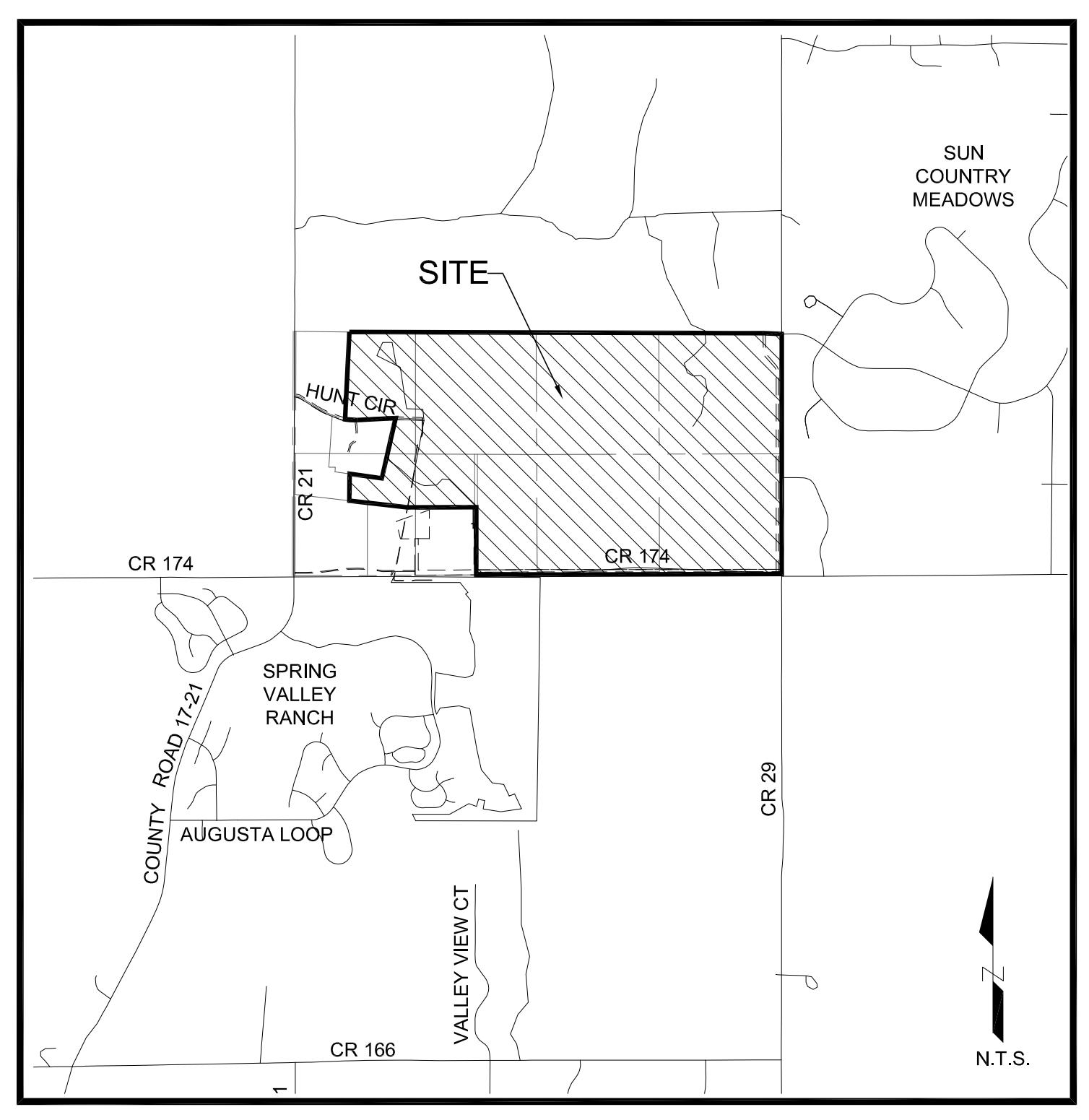
Elbert County commissioners are scheduled to consider a service plan for five metropolitan districts serving The Ridge at Spring Valley, a proposed housing development whose financing model could support up to $128.8 million in collective debt for roads, utilities and other improvements.
The Planning Commission voted 8-0 on Aug. 4 to recommend approval of the consolidated plan, draft minutes show. The commission also recommended that the county consider requiring an early transition from developer control to residential governance, as soon as state law permits.
The plan covers one operating district and four bonding districts. The Planning Commission recommendation did not approve the districts, their debt or the proposed transition language. The Board of County Commissioners is scheduled to hold a public hearing Sept. 9, 2026. County staff recommends approval if the districts meet statutory creation criteria, a staff memorandum says.
The districts would serve the county-approved Ridge at Spring Valley planned unit development, formerly called Moorstead. The development allows up to 1,191 homes on about 1,100 acres north of County Road 174 between County roads 21 and 29. The financial model uses 1,193 homes; the records reviewed do not explain the discrepancy. They also do not provide full legal descriptions or parcel-level maps for the five districts, so their final boundaries cannot be independently stated.
What the plan would finance
The districts would finance, build, own, operate and maintain interior roads, drainage and detention facilities, water-quality ponds, pocket parks, trails, and water and sewer infrastructure. The plan estimates about $134.7 million in public-improvement costs, including roughly $27.4 million to expand water-production and wastewater-treatment facilities.
Spring Valley Metropolitan District No. 1 is expected to own and operate the water and sanitation improvements under intergovernmental agreements. The districts also would coordinate water distribution, sewage collection and customer billing through that arrangement.
The proposal would use special-district financing rather than the county general fund. Debt could be repaid through property taxes and fees, with utility and development charges providing additional revenue. The available materials do not establish which future fees or tap charges would be binding rather than modeled assumptions.
What homeowners could pay
The service plan sets a maximum debt levy of 65 mills, subject to adjustments for changes in assessment rates and related tax laws. Residential debt generally could be levied for up to 40 years unless a district board with a majority of resident or end-user members votes to extend the term. The plan does not cap operations-and-maintenance mill levies.
In an illustrative tax-year 2025 model, the debt levy is adjusted to 74.360 mills and the operations levy to 17.160 mills, for a combined 91.520 mills.
For a hypothetical home valued at $631,643, Anderson Analytics estimates annual property taxes of $6,726 under its tax-year 2025 assumptions. About $3,113 would go to existing overlapping taxing entities and $3,613 to the proposed districts — approximately $2,936 for debt service and $677 for operations and maintenance. The report also says homeowners should expect separate homeowners association fees.
The estimate depends on assessed values, assessment rates, levy decisions, interest rates, development pace and other assumptions. It is not a current tax bill or a guarantee of future charges.
The modeled bond structure
The financial model assumes a $76.24 million general-obligation bond issue in 2027 and a $117.115 million issue in 2037. The latter includes $72.875 million to refund the earlier bonds and $46.264 million in new project costs. Because refunded principal is not counted as new debt, the sources-and-uses tables count $128.765 million toward the five-district debt limit, rounded in the service plan to $128.8 million.
The model assumes 5% interest on the 2027 bonds and 4% on the 2037 bonds. It describes the timing, rates, phasing and bond sizes as illustrative; actual issuances could differ. The financial plan projects home construction from 2028 through 2039 and uses assessed-value and debt-service assumptions to show the proposed financing could support the development. It does not represent a bond sale or debt already incurred.
At the Sept. 9 hearing, commissioners could approve, reject or modify the request. Until then, the districts, their boundaries, debt and levy authority, infrastructure obligations and any transition to residential governance remain proposed.